While celebrating the successes of 2025, we wanted to take this opportunity to wish you a peaceful start of the year. And what better way to do so, than through a puzzle? In this page, we discuss the background of the puzzle shared through our Social Media post and provide a couple of tips and tricks to help you solve it.
🎅Following a busy Christmas, Santa returned home in Lapland to get some well-deserved rest.
He will soon need to start seeing who is naughty XOR nice in 2026.
⏰When completing his last stop in Malta, the local time read 23:54.
❓How many minutes have passed since then? Use this as adecimal key to decode this message:
W~iz?~?mzlkyjs?Qzh?Fz~m?2?}jk?mzrzr}zm3?|f}zm?kwmz~kl?qzizm?mzlk1?Lk~f?ivxvs~qk
Background Information
Encryption and ‘XOR’
Encryption is a process used to protect information by converting it from a readable format, known as plaintext, into an unreadable format called cipher text. This transformation is achieved using an encryption algorithm and a key, which is a piece of information required to perform the conversion. Only someone with the correct key can decrypt the cipher text back into its original, understandable form, ensuring that sensitive data remains secure from unauthorised access.
One simple method of encryption is the XOR (exclusive OR) technique, which operates by comparing each bit of the plaintext with the corresponding bit of a key using the XOR operation. If the bits are the same, the result is 0; if they are different, the result is 1. To decrypt the message, the same key is used with the XOR operation on the cipher text, effectively reversing the process and restoring the original information.
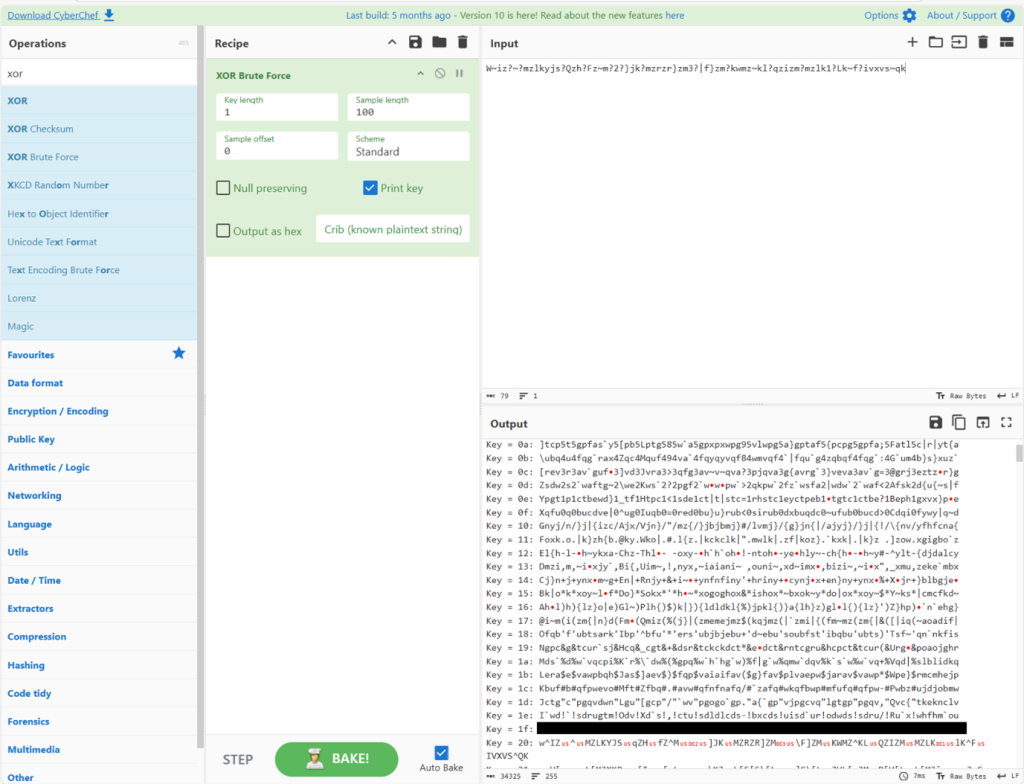
This approach is straightforward but relies heavily on the secrecy and randomness of the key to maintain security. If the key is short, predictable, or reused, attackers can easily brute-force all possible key values to decrypt the message. This makes XOR unsuitable for protecting sensitive information unless a truly random and sufficiently long key is used. In fact, the solution to this puzzle can be brute-forced as explained in ‘Solution Method 2’ below
Time Zones
Time zones are regions of the globe that observe the same standard time, usually defined by their offset from the prime meridian, which is located at Greenwich, London. Malta operates on Central European Time (CET, UTC+1), while Lapland in Finland uses Eastern European Time (EET, UTC+2). This means that Lapland is one hour ahead of Malta.
Solution Method 1 – Step By Step
Combining the above two pieces of knowledge is needed to solve the challenge.
Step 1. Finding the time difference in minutes.
If Santa left Malta at 23:54 and the current time reads 01:25, there is 1 hour 31 minutes (91 minutes) difference, however when factoring in the difference in time zones, we need to subtract 1 hour (60 minutes) of actual travel time.
That adds up to 31 minutes (60 minutes for time zone, plus 31 minutes of travel)
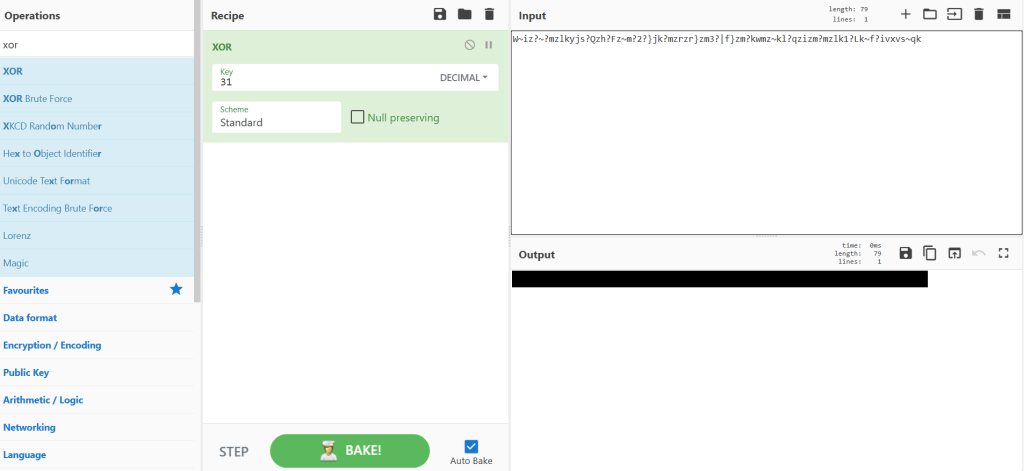
Step 2. Decrypting the message using XOR
To decrypt the message with the key of ‘31’ in decimal discovered earlier, one needs to use a tool that can process the necessary XOR algorithm. One good resource to do such a task is https://cyberchef.io, containing a collection of over 200 operations that can be useful in manipulating text into various forms, including encryption, hash functions and performing basic data forensics.
Solution Method 2 – Brute-force
Although XOR demonstrates the key components behind encryption, since an initial input is tranformed into an encrypted cypher text, using a secret key, the XOR algorithm is fairly simple to decode, and does not require much computational complexity.
For this reason, the solution to this puzzle has a small enough key size to be brute-forced, meaning that if one would like to try multiple possible solutions till they get a meaningful answer, they can easily get to the answer. Online tools such as XOR Cipher Decoder & Encoder – Online XOR Decryption Tool | Inventive HQ offer this functionality.
Due to the low complexity, this puzzle demonstrates the importance of using more advanced encryption algortihtms for real life scenarios, and also the importance of having a key of larger length.